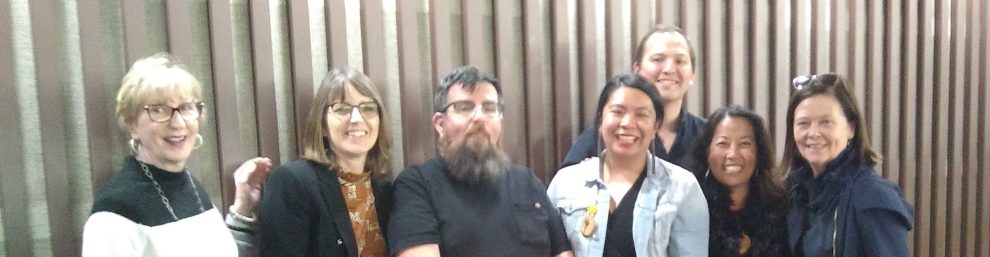
Felicia Larson and Beverly Perez: A favorite poem

The Road Not Taken
by Robert Frost

It brings tears to my eyes even now as I read it, remembering the young woman (not yet twenty) that I was when I first encountered it. I wanted a life characterized by adventure, not necessarily risk. This poem gave me permission to take the roads that gave me pause. Those that made me feel like, if I did not venture down them I would be missing out. And yet just as true for some of the roads I did not take. Few regrets and yet I sigh. The road less traveled by has made all the difference.

Felicia Larson
Associate Certified Coach, Speaker, & Writer
Los Gatos

* * *

This poem describes my life and the decisions I’ve had to make. The more I grow, the more decisions I need to make for myself and sometimes I panic and wonder if I made the right one, if I took the right road. During elementary school I had to memorize this poem and ever since then it stuck with me, and as I grew up I found it described my growing up perfectly. The end of the poem is what I love the most, because the decision I have made “has made all the difference.” So much is said with this poem, definitely a favorite of mine.


Beverly Perez
Student

San Jose State University


The Road Not Taken

Two roads diverged in a yellow wood,
And sorry I could not travel both
And be one traveler, long I stood
And looked down one as far as I could
To where it bent in the undergrowth;

Then took the other, as just as fair,
And having perhaps the better claim,
Because it was grassy and wanted wear;
Though as for that the passing there
Had worn them really about the same,

And both that morning equally lay
In leaves no step had trodden black.
Oh, I kept the first for another day!
Yet knowing how way leads on to way,
I doubted if I should ever come back.

I shall be telling this with a sigh
Somewhere ages and ages hence:
Two roads diverged in a wood, and I-
I took the one less traveled by,
And that has made all the difference.


Robert Frost

Leave a comment

Filed under Favorite Poem

Angelique Mabanglo and Moniyka Sachar: A favorite poem

Nothing Gold Can Stay
by Robert Frost

I love Robert Frost’s poem Nothing Gold Can Stay because of the simple language and the description of how time comes and goes so quickly. Frost uses the essence of time captured in the description of nature’s greenness an how it never stays long. The greenness is the “golden age” of nature.

Angelique Mabanglo, 21
Student
San Jose

* * *


I first read this poem in middle school, from the classic novel “The Outsiders”, a bildungsroman story detailing a young boy’s transition from childhood to adolescence. I am aware of the biblical allusions and the intricate analysis of synecdoche in this poem, yet to me it simply symbolizes how youth, success, or goodness never last forever. This poem encompassed the reality of growing up for me, and my bitter parting from Disney happily-ever-afters, the tooth fairy, princess themed birthday parties, and ultimately, my naivety. Although I am still young, my pure innocence is nevertheless my “hardest hue to hold” (Frost).

Moniyka Sachar
High School Student
Fremont

(Note from Poet Laureate: Though Moniyka resides just outside our county, I’m including her comments to this County submission to support High School students anywhere as readers of poetry. Thanks, Moniyka)


Nothing Gold Can Stay

Nature’s first green is gold,
Her hardest hue to hold.
Her early leaf’s a flower;
But only so an hour.
Then leaf subsides to leaf.
So Eden sank to grief,
So dawn goes down to day.
Nothing gold can stay.

Robert Frost

Leave a comment

Filed under Favorite Poem

Stephanie Pressman: A favorite poem

Journey of the Magi
by T.S. Eliot

When I considered what my favorite poem would be, the first one that
came to mind was “Journey of the Magi,” by T.S. Eliot. It is one of
those poems that allowed me to discover myself, who I would have been
in that place of dirty cities and unfriendly towns. It put me into a
different landscape and taught me how emotions could be objectified,
and how an experience of great historical significance could be
revisited, reinterpreted and made immediate.

Stephanie Pressman
Poet, Graphic Designer and small press publisher
Cupertino


Journey of the Magi

‘A cold coming we had of it,
Just the worst time of the year
For the journey, and such a long journey:
The ways deep and the weather sharp,
The very dead of winter.’
And the camels galled, sore-footed, refractory,
Lying down in the melting snow.
There were times we regretted
The summer palaces on slopes, the terraces,
And the silken girls bringing sherbet.
Then the camel men cursing and grumbling
And running away, and wanting their liquor and women,
And the night-fires going out, and the lack of shelters,
And the cities hostile and the towns unfriendly
And the villages dirty and charging high prices:
A hard time we had of it.
At the end we preferred to travel all night,
Sleeping in snatches,
With the voices singing in our ears, saying
That this was all folly.

Then at dawn we came down to a temperate valley,
Wet, below the snow line, smelling of vegetation;
With a running stream and a water-mill beating the darkness,
And three trees on the low sky,
And an old white horse galloped away in the meadow.
Then we came to a tavern with vine-leaves over the lintel,
Six hands at an open door dicing for pieces of silver,
And feet kicking the empty wine-skins,
But there was no information, and so we continued
And arrived at evening, not a moment too soon
Finding the place; it was (you may say) satisfactory

All this was a long time ago, I remember,
And I would do it again, but set down
This set down
This: were we led all that way for
Birth or Death? There was a Birth, certainly,
We had evidence and no doubt. I had seen birth and death,
But had thought they were different; this Birth was
Hard and bitter agony for us, like Death, our death,
We returned to our places, these Kingdoms,
But no longer at ease here, in the old dispensation,
With an alien people clutching their gods.
I should be glad of another death.

T.S. Eliot

1 Comment

Filed under Favorite Poem

Sophia Zohdi: A favorite poem

The Love Song of J. Alfred Prufrock
by T.S. Eliot

“The Love Song of J. Alfred Prufrock” by T.S. Eliot has been my favorite poem since high school. There are countless interpretations of the text, but to me, the poem has always been about coming to terms with aging, as well as the tragic deconstruction of a socially awkward man’s mind. The imagery is beautiful and the text flows smoothly. It almost reads like a sophisticated rant. One cannot help but pity Prufrock and his tendency to overthink things that are so simple and irrelevant, as so many people do. He created his own hell in his insecurities.

Sophia Zohdi
20 years old; Student SJSU
German and English Literature
Morgan Hill


The Love Song of J. Alfred Prufrock

S’io credesse che mia risposta fosse
A persona che mai tornasse al mondo,
Questa fiamma staria senza piu scosse.
Ma perciocche giammai di questo fondo
Non torno vivo alcun, s’i’odo il vero,
Senza tema d’infamia ti rispondo.

Let us go then, you and I,
When the evening is spread out against the sky
Like a patient etherized upon a table;
Let us go, through certain half-deserted streets,
The muttering retreats
Of restless nights in one-night cheap hotels
And sawdust restaurants with oyster-shells:
Streets that follow like a tedious argument
Of insidious intent
To lead you to an overwhelming question…
Oh, do not ask, “What is it?”
Let us go and make our visit.

In the room the women come and go
Talking of Michelangelo.

The yellow fog that rubs its back upon the window-panes,
The yellow smoke that rubs its muzzle on the window-panes
Licked its tongue into the corners of the evening,
Lingered upon the pools that stand in drains,
Let fall upon its back the soot that falls from chimneys,
Slipped by the terrace, made a sudden leap,
And seeing that it was a soft October night,
Curled once about the house, and fell asleep.

And indeed there will be time
For the yellow smoke that slides along the street,
Rubbing its back upon the window-panes;
There will be time, there will be time
To prepare a face to meet the faces that you meet;
There will be time to murder and create,
And time for all the works and days of hands
That lift and drop a question on your plate;
Time for you and time for me,
And time yet for a hundred indecisions,
And for a hundred visions and revisions,
Before the taking of a toast and tea. Continue reading

Leave a comment

Filed under Favorite Poem

Tiffany Garcia: A favorite poem

Poem #236
by Emily Dickinson

Raised as a Catholic, I myself have attended church every Sunday since I can remember. I have recently stopped going because I question its politics. I know of many people who have acted unforgivably yet, attend church regularly. They think their souls are in no jeopardy because they attend weekly services and they fear for mine because I don’t. I justify my own feelings as others should. This poem does just that; it is telling us to follow what we believe, not what others tell us to believe in. I still hold great faith in God; I just choose not to follow his disciples or those who claim to be. I believe God will accept me and for what I believe, even if those around me will not.

Tiffany Garcia
22 years old; Student and Senior Library Page, SJSU
Santa Clara


Poem #236

Some keep the Sabbath going to Church —
I keep it, staying at Home —
With a Bobolink for a Chorister —
And an Orchard, for a Dome —

Some keep the Sabbath in Surplice —
I just wear my Wings —
And instead of tolling the Bell, for Church,
Our little Sexton — sings.

God preaches, a noted Clergyman —
And the sermon is never long,
So instead of getting to Heaven, at least —
I’m going, all along.

Emily Dickinson

2 Comments

Filed under Favorite Poem

Angela Langone: A favorite poem

Poem #35
by Emily Dickinson

This poem is my favorite poem since it explains such a small aspect of nature and how people can sometimes take these things for granted. The rose symbolizes a small, perfect, beautiful, natural thing which other naturalistic community members such as birds, the breeze, bees, and butterflies will miss. I think that this poem can be interpreted in a more recent fashion as well, in regards to human civilizations and how we are interfering with nature’s communities. A small rose dying is nothing compared to a human dying in our perspective, but we do need to be aware of our impact on nature.

Angela Langone
22 years old; Student SJSU
Morgan Hill


Poem #35

Nobody knows this little Rose —
It might a pilgrim be
Did I not take it from the ways
And lift it up to thee.
Only a Bee will miss it —
Only a Butterfly,
Hastening from far journey —
On its breast to lie —
Only a Bird will wonder —
Only a Breeze will sigh —
Ah Little Rose — how easy
For such as thee to die!

Emily Dickinson

Leave a comment

Filed under Favorite Poem

Orion Petitclerc: A favorite poem

Poem # 112
by Emily Dickinson

This poem immediately spoke to me the first time I read it, so much so that I took a picture of it with my phone camera and posted it on Facebook for everyone to know that I found a poem I LIKE.  It gives me comfort in working towards my goals to know that those who are already successful don’t know what they really have.  It makes the unsuccessful, yet hard-working people seem more humble in knowing the true value of something.  There should be a stanza about dating in there somewhere!

Orion Petitclerc
Age 21, Full-time student
San José


Poem #112

Success is counted sweetest
By those who ne’er succeed.
To comprehend a nectar
Requires sorest need.


Not one of all the purple Host
Who took the Flag today
Can tell the definition
So clear of victory


As he defeated – dying –
On whose forbidden ear
The distant strains of triumph
Burst agonized and clear!

Leave a comment

Filed under Favorite Poem

Carolyn Donnell: A favorite poem

[i carry your heart with me(i carry it in]
by E. E. Cummings

This is one of my favorite poems. It expresses what I have not always been able to say in words myself. It’s as simple as that.

Carolyn Donnell
Writer
Santa Clara

[i carry your heart with me(i carry it in]

i carry your heart with me(i carry it in
my heart)i am never without it(anywhere
i go you go,my dear;and whatever is done
by only me is your doing,my darling)
                                                      i fear
no fate(for you are my fate,my sweet)i want
no world(for beautiful you are my world,my true)
and it’s you are whatever a moon has always meant
and whatever a sun will always sing is you

here is the deepest secret nobody knows
(here is the root of the root and the bud of the bud
and the sky of the sky of a tree called life;which grows
higher than soul can hope or mind can hide)
and this is the wonder that’s keeping the stars apart

i carry your heart(i carry it in my heart)

E. E. Cummings


1 Comment

Filed under Favorite Poem

Pushpa MacFarlane and Dennis Richardson: A favorite poem

Lanyard
by Billy Collins

All through growing up, I made handmade gifts for my family. Aside from making their dresses and personalized birthday cakes, I always surprised them with store-bought presents I knew they would like, but never expected. I didn’t want them to be embarrassed by my handmade gifts in front of friends. I regret I didn’t pass on this valued experience to my kids.  When I first read this poem it hit me in my gut—it still does every time. I believe it was written for me. I can now pass this on to them. So this one’s for you, kids…


Pushpa MacFarlane
Healthcare Representative
San Jose


In 2002, my wife and I went to the Geraldine R. Dodge Poetry Festival in New Jersey. Having only read some of my wife’s poetry, I had never done anything with poetry except in high school and that says it all. The first poet we heard at the festival was Billy Collins. The poem was so well written, catchy in its presentation and really funny in its exaggeration, I was not ready for the ending when it hit me. So poignant, with a few tears in my eyes, I knew I would read and write poetry from that day on and, indeed, I wrote my first poem the next morning.

Dennis Richardson
Retired Math Teacher
San José


Lanyard

The other day I was ricocheting slowly
off the blue walls of this room,
moving as if underwater from typewriter to piano,
from bookshelf to an envelope lying on the floor,
when I found myself in the L section of the dictionary
where my eyes fell upon the word lanyard.

No cookie nibbled by a French novelist
could send one into the past more suddenly—
a past where I sat at a workbench at a camp
by a deep Adirondack lake
learning how to braid long thin plastic strips
into a lanyard, a gift for my mother.

I had never seen anyone use a lanyard
or wear one, if that’s what you did with them,
but that did not keep me from crossing
strand over strand again and again
until I had made a boxy
red and white lanyard for my mother.

She gave me life and milk from her breasts,
and I gave her a lanyard.
She nursed me in many a sick room,
lifted spoons of medicine to my lips,
laid cold face-cloths on my forehead,
and then led me out into the airy light

and taught me to walk and swim,
and I, in turn, presented her with a lanyard.
Here are thousands of meals, she said,
and here is clothing and a good education.
And here is your lanyard, I replied,
which I made with a little help from a counselor. Continue reading

3 Comments

Filed under Favorite Poem

Imelda Gonzalez: A favorite poem

Freeway 280
by Lorna Dee Cervantes

I first read this poem in the early 90’s as a college student at Stanford.  I’d take the 280 south to San José, then hop on the 101 to get home to Soledad.  Back then it reminded me of a specific area of San José.  I now know the area to be the Washington-Guadalupe and the Spartan-Keyes Neighborhoods.  The plants under the 280 still grow lush and green after rainfalls.  I have spotted women near the freeway picking verdolagas (purslane) to take home and make with mole.  Flowering fruit trees can be seen from the freeway in yards.  The 280 is the freeway I still take to get home – to San José.

Imelda Gonzalez
Human Resources Manager
San José


Freeway 280

Las casitas near the gray cannery,
nestled amid wild abrazos of climbing roses
and man-high red geraniums
are gone now.The freeway conceals it
all beneath a raised scar.

But under the fake windsounds of the open lanes,
in the abandoned lots below, new grasses sprout,
wild mustard remembers, old gardens
come back stronger than they were,
trees have been left standing in their yards.
Albaricoqueros, cerezos, nogales . . .
Viejitas come here with paper bags to gather greens.
Espinaca, verdolagas, yerbabuena . . .

I scramble over the wire fence
that would have kept me out.
Once, I wanted out, wanted the rigid lanes
to take me to a place without sun,
without the smell of tomatoes burning
on swing shift in the greasy summer air.

Maybe it’s here
en los campos extraños de esta ciudad
where I’ll find it, that part of me
mown under
like a corpse
or a loose seed.

Lorna Dee Cervantes

1 Comment

Filed under Favorite Poem