A wonderful time was had by all: First Favorite Poems Reading

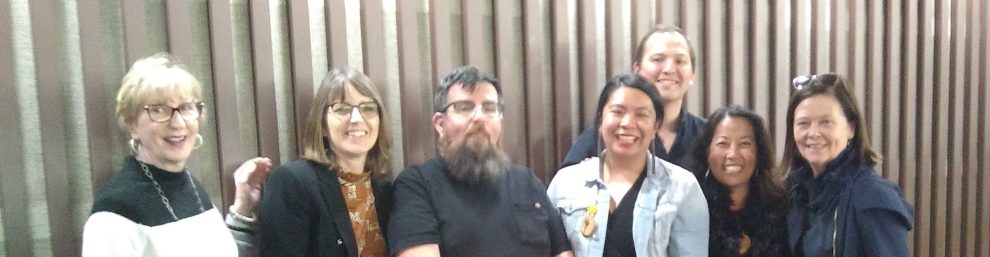
This past Sunday afternoon at the Stevens Creek Barnes & Noble, I hosted the first reading of favorite poems to an overflow audience. With over 60 people in attendance, Barnes & Noble management had to bring out more chairs. It was a terrific audience who found themselves laughing, pondering, moved to tears, all the while listening attentively as a wide variety of favorite poems were read. The readers–poets and non-poets alike–each made personal remarks as to why they’d chosen that particular poem, and I felt privileged to hear such thoughtful reflections shared. It’s the same way I feel as I read and re-read the poetry submissions that I post, and I hope you too feel drawn in. Here’s a photo of Sunday’s participants. Their names and poems read are listed above in the “List of Readers” link in the header. My hat’s off to these 12 who helped create a memorable event.


I’m looking forward to announcing the next reading event, and hope to bring together another terrific bunch of readers. Maybe you?

Sally Ashton
Santa Clara County Poet Laureate

3 Comments

Filed under Laureate's News

Mary Matlack: A favorite poem

Jabberwocky
by Lewis Carroll

When I was in 4th grade at Saratoga School, my teachers Mrs. Hendry and Mr. Gallagher asked us to memorize a poem. My family helped me pick “Jabberwocky” by Lewis Carroll. It took weeks to memorize, but I did it and embellished the performance by holding a flashlight under my chin and turning out the lights. When it came time for me to read the poem, I  could not do it. The teachers understood, and in another few weeks, I was able to recite the poem. I recite it for my children now and they love it. I love the language and the mood it creates.

Mary Matlack
Mother
San Jose


Jabberwocky

‘Twas brillig, and the slithy toves
Did gyre and gimble in the wabe:
All mimsy were the borogoves,
And the mome raths outgrabe.

‘Beware the Jabberwock, my son!
The jaws that bite, the claws that catch!
Beware the Jubjub bird, and shun
The frumious Bandersnatch!’

He took his vorpal sword in hand:
Long time the manxome foe he sought —
So rested he by the Tumtum tree,
And stood a while in thought.

And, as in uffish thought he stood,
The Jabberwock, with eyes of flame,
Came whiffling through the tulgey wood,
And burbled as it came!

One two! One two! And through and through
The vorpal blade went snicker-snack!
He left it dead, and with its head
He went galumphing back.

‘And hast thou slain the Jabberwock?
Come to my arms, my beamish boy!
Oh frabjous day! Callooh! Callay!’
He chortled in his joy.

‘Twas brillig, and the slithy toves
Did gyre and gimble in the wabe:
All mimsy were the borogoves,
And the mome raths outgrabe.

Lewis Carroll
(1832-1898)

Leave a comment

Filed under Favorite Poem

Karen English: A favorite poem

Contemplations
by Anne Bradstreet

One of my favorite poems is Anne Bradstreet’s Contemplations (1678).  It is the first poem in English about the beauty of the American landscape; it has a great opening line: “Some time now past in the autumnal tide”; and in stanza 24, the speaker addresses fishes wistfully:  “In lakes and ponds you leave your numerous fry; / So nature taught, and yet you know not why, / You wat’ry folk that know not your felicity” (166-68).  Bradstreet was a poet and a mother of eight–no wonder she admires the habits of fish-moms.

Karen English
Professor of English, San Jose State University
San Jose


Contemplations

1
Sometime now past in the Autumnal Tide,
When Phoebus wanted but one hour to bed,
The trees all richly clad, yet void of pride,
Were gilded o’re by his rich golden head.
Their leaves and fruits seem’d painted but was true
Of green, of red, of yellow, mixed hew,
Rapt were my senses at this delectable view.
2
I wist not what to wish, yet sure thought I,
If so much excellence abide below,
How excellent is he that dwells on high?
Whose power and beauty by his works we know.
Sure he is goodness, wisdom, glory, light,
That hath this under world so richly dight.
More Heaven than Earth was here, no winter and no night.
3
Then on a stately Oak I cast mine Eye,
Whose ruffling top the Clouds seem’d to aspire;
How long since thou wast in thine Infancy?
Thy strength and stature, more thy years admire,
Hath hundred winters past since thou wast born?
Or thousand since thou brakest thy shell of horn,
If so, all these as nought, Eternity doth scorn.
4
Then higher on the glistering Sun I gaz’d,
Whose beams was shaded by the leafy Tree.
The more I look’d, the more I grew amaz’d
And softly said, what glory’s like to thee?
Soul of this world, this Universe’s Eye,
No wonder some made thee a Deity:
Had I not better known (alas) the same had I. Continue reading

Leave a comment

Filed under Favorite Poem

Jim Mehl: A favorite poem

from “Auguries of Innocence”
by William Blake

To me this has always conveyed the essence of the Silicon Valley. It is not just the sand/silicon relationship, but also the sense of wonder and challenge that exists in the Valley.

Jim Mehl
Retired IBM computer scientist and software engineer
Los Gatos


fromAuguries of Innocence” 

To see a World in a Grain of Sand
And a Heaven in a Wild Flower,
Hold Infinity in the palm of your hand
And Eternity in an hour.

William Blake
(1757-1827)

Leave a comment

Filed under Favorite Poem

Ed Sams: A favorite poem

The Arrest of Oscar Wilde at the Cadogan Hotel
John Betjeman

I find that modern poets can’t manage folk ballads, except John Betjeman.  His “The Arrest of Oscar Wilde at the Cadogan Hotel” develops a complete narrative in only nine terse verses.  There is an epigram worthy of Wilde himself:  “Approval of what is approved of/ Is as false as a well-kept vow.”  There is irony in the repeated line “This is the Cadogan Hotel” first by Wilde as a comment on the staff and then by the police as a comment on Wilde.  With Wilde now the vanguard of a civil rights movement, the poem still manages to be relevant.

Ed Sams
Lecturer, San Jose State University


The Arrest of Oscar Wilde at the Cadogan Hotel

He sipped at a weak hock and seltzer
As he gazed at the London skies
Through the Nottingham lace of the curtains
Or was it his bees-winged eyes?

To the right and before him Pont Street
Did tower in her new built red,
As hard as the morning gaslight
That shone on his unmade bed.

“I want some more hock in my seltzer,
And Robbie, please give me your hand–
Is this the end or beginning?
How can I understand?

“So you’ve brought me the latest Yellow Book
And Buchan has got in it now:
Approval of what is approved of
Is as false as a well-kept vow. Continue reading

Leave a comment

Filed under Favorite Poem

Marilyn Manzo: A favorite poem

Rags for Heaven
by Clem Bascar

This poem to me is one of the most powerful, deeply moving, and beautiful poems that I’ve ever read. It caused goosebumps, stayed in the brain like forever….and made me feel closer to heaven.

Marilyn Manzo, Inpatient Pharmacy Department, SCVMC
Milpitas


Rags for Heaven

It isn’t the exercise of power that one gains strength
but in its constant restraint;
the greatest being that ever lived
won eternity in his stillness.

It isn’t in the arrogant display of authority
that one begets respect,
but how fairly and humbly one dispenses it;
Justice isn’t giving someone what he needs
but what he truly deserves.

No one acquires dignity in the sufferings of others
nor nobility at the expense of the slaves;

Heaven comes closer to one
who gives up the best part of himself
to fill
the emptiness of others.

Clem Bascar
from Fragments of the Eucharist

4 Comments

Filed under Favorite Poem

Greg Hawkins: A favorite poem

The Unknown Citizen
by W.H. Auden

This is a poem, which when I first read it five years ago, spoke loudly to me, and it seems to still speak loudly about the human condition of today. It seemed to say everything that I and many people I knew had gone through growing up, especially when you meet a person who speaks and acts just like this “Unknown Citizen” and you get that eerie feeling during and after the encounter. This is a poem for any “Modern Man/Woman” who questions and observes the times in which he lives.  This poem makes you wonder about the direction we are heading in as “people.”

Greg Hawkins, 24
Tutor/Student, San Jose


The Unknown Citizen

He was found by the Bureau of Statistics to be
One against whom there was no official complaint,
And all the reports on his conduct agree
That, in the modern sense of an old-fashioned word, he was a saint,
For in everything he did he served the Greater Community.
Except for the War till the day he retired
He worked in a factory and never got fired
But satisfied his employers, Fudge Motors Inc.
Yet he wasn’t a scab or add in his views,
For his Union reports that he paid his dues,
(Our report on the Union shows it was sound)
And our Social Psychology workers found
That he was popular with his mates and liked a drink.
The Press are convinced that he bought a paper every day
And that his reactions to advertisements were normal in every way
Policies taken out in his name prove that he was fully insured,
And his Health-card shows he was once in hospital but left it cured.
Both Producers Research and High-Grade Living declare
He was fully sensible to the advantages of the Installment Plan
And had everything necessary to the Modern Man,
A phonograph, a radio, a car and a frigidaire.
Our researchers into Public Opinion are content
That he held the proper opinions for the time of the year;
When there was peace, he was for peace, when there was war, he went.
He was married and added five children to the population,
Which our Eugenist says was the right number for a parent of his generation.
And our teachers report that he never interfered with their education.

Was he free? Was he happy? The question is absurd:
Had anything been wrong, we should certainly have heard.


W.H. Auden

(1907-1973)

Leave a comment

Filed under Favorite Poem

Sarah Shotwell: A favorite poem

Law, Like Love
by W.H. Auden

When I was in graduate school at the University of Washington, I had the rather thrilling experience of taking a poetry criticism course from the great poet David Wagoner, who today is 85 years old and, thankfully, still teaching.  During our course, he frequently expressed the importance to the heart and mind of memorizing poetry. Sometime in the first week of class,  after some students had begun to bicker about the meaning of the law, he sat back in his chair and began to recite Auden’s poem, only whispering at first, and then building with an intensity and tenderness that took our breath away (He later told us that he had done the same thing while sitting on a rather important and volatile philosophy panel about the nature of the law). Whether it was that childlike nursery rhyme cadence or the gentle, humble turn at its end, the poem silenced us and moved me in an inexplicably visceral way.  I went on to memorize it, and I recite it regularly to keep it on my tongue. Auden’s stunning truth has now worked its way into my very heartbeat, just like my teacher said it would.

Sarah Shotwell, Writer
San Jose


Law, Like Love

Law, say the gardeners, is the sun,
Law is the one
All gardeners obey
To-morrow, yesterday, to-day.

Law is the wisdom of the old,
The impotent grandfathers feebly scold;
The grandchildren put out a treble tongue,
Law is the senses of the young.

Law, says the priest with a priestly look,
Expounding to an unpriestly people,
Law is the words in my priestly book,
Law is my pulpit and my steeple.

Law, says the judge as he looks down his nose,
Speaking clearly and most severely,
Law is as I’ve told you before,
Law is as you know I suppose,
Law is but let me explain it once more,
Law is The Law.

Yet law-abiding scholars write:
Law is neither wrong nor right,
Law is only crimes
Punished by places and by times,
Law is the clothes men wear
Anytime, anywhere,
Law is Good morning and Good night.

Others say, Law is our Fate;
Others say, Law is our State;
Others say, others say
Law is no more,
Law has gone away. Continue reading

Leave a comment

Filed under Favorite Poem

Kendall Romo: A favorite poem

Phenomenal Woman
by Maya Angelou

I like this poem because it is celebrates women in a positive light.  The poem demonstrates the theme of feminine power. Not only does Maya Angelou illustrate women as powerful human beings, she praises the physical and emotional characteristics women have.  Through her words, Maya Angelou brings about the theme of why women are lovable and amazing!

Kendall Romo
17 years old, Student at Presentation High School
Milpitas

Phenomenal Woman

Pretty women wonder where my secret lies.
I’m not cute or built to suit a fashion model’s size
But when I start to tell them,
They think I’m telling lies.
I say,
It’s in the reach of my arms,
The span of my hips,
The stride of my step,
The curl of my lips.
I’m a woman
Phenomenally.
Phenomenal woman,
That’s me.

I walk into a room
Just as cool as you please,
And to a man,
The fellows stand or
Fall down on their knees.
Then they swarm around me,
A hive of honey bees.
I say,
It’s the fire in my eyes,
And the flash of my teeth,
The swing in my waist,
And the joy in my feet.
I’m a woman
Phenomenally.

Phenomenal woman,
That’s me.

Leave a comment

Filed under Favorite Poem

R. C. Nemer: A favorite poem

School Prayer
by Diane Ackerman

Thank you for the opportunity to share one of my favorite poems (I can’t name just one favorite). Many years ago I posted the following poem at my desk. It helps me to remember to deflect hate and destruction with love and compassion – towards humanity, the animal world, and the environment.

R. C. Nemer
Sunnyvale

School Prayer

In the name of the daybreak
and the eyelids of morning
and the wayfaring moon
and the night when it departs,

I swear I will not dishonor
my soul with hatred,
but offer myself humbly
as a guardian of nature,
as a healer of misery,
as a messenger of wonder,
as an architect of peace.

In the name of the sun and its mirrors
and the day that embraces it
and the cloud veils drawn over it
and the uttermost night
and the male and the female
and the plants bursting with seed
and the crowning seasons
of the firefly and the apple,

I will honor all life
—wherever and in whatever form
it may dwell—on Earth my home,
and in the mansions of the stars.

Diane Ackerman

3 Comments

Filed under Favorite Poem